Mapping Interconnected Match Variables for Dependable Soccer Accumulator Builds
Leon Keller · Aug 8, 2026

Mapping Interconnected Match Variables for Dependable Soccer Accumulator Builds
Observers in the sports betting sector note that linked events in soccer create chains of dependency across multiple fixtures, and analysts track these connections through statistical models that separate independent outcomes from those influenced by shared factors such as team motivation, travel fatigue, or pitch conditions. Data from major European leagues during the 2025-2026 campaign shows that accumulators built without accounting for these linkages experience higher variance in returns, whereas sequences constructed around verified independent variables maintain steadier progression across betting cycles.
Identifying Core Linkages in Soccer Fixtures
Researchers at institutions focused on sports analytics have catalogued several recurring dependencies that appear when bettors combine results from concurrent matches. Player availability lists released by clubs in late July often influence both a team's home and away fixtures in the opening weeks, creating measurable correlations between early-season points totals. Weather databases maintained by meteorological agencies across the continent record that prolonged rainfall periods in August 2026 affected multiple northern European venues simultaneously, altering goal-scoring rates in matches that otherwise appeared unrelated on paper.
Form trackers maintained by performance data providers reveal that a side's defensive organisation carries over when the same backline faces opponents with similar attacking profiles within a short window. Analysts therefore cross-reference fixture schedules against historical head-to-head data to flag potential overlaps before constructing longer accumulator sequences.
Constructing Sequences Around Verified Independence
Professional syndicates apply correlation matrices derived from league-wide datasets to test proposed accumulator legs for statistical independence. These matrices assign coefficients to variables including rest days between matches, managerial changes, and referee assignment patterns. When two fixtures share coefficients above established thresholds, syndicates either remove one leg or adjust stake allocation to compensate for the elevated joint probability.
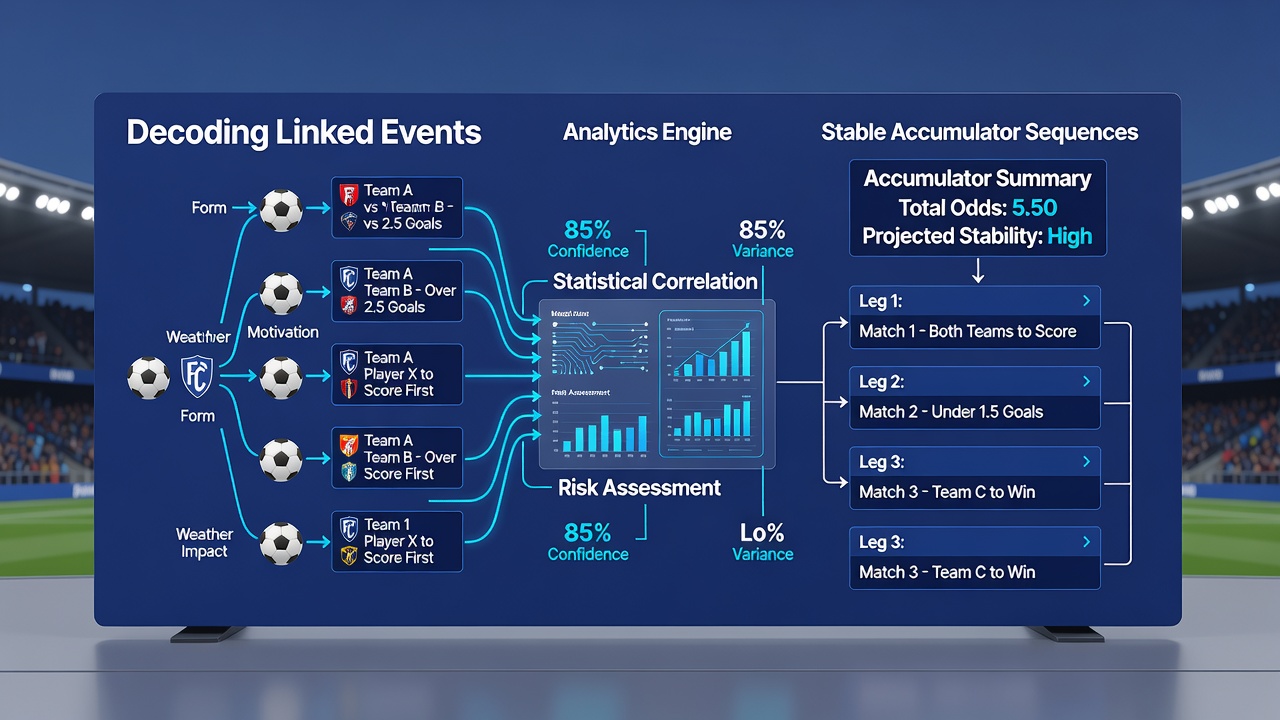
European tournament organisers publish fixture calendars well in advance, allowing data teams to simulate thousands of outcome combinations through Monte Carlo methods. The resulting distributions highlight sequences where individual match results remain sufficiently decoupled to support progressive staking plans across multiple rounds. One documented workflow involves layering league matches from geographically distant regions first, then adding cup ties only after confirming that travel and squad rotation factors do not create hidden linkages.
Data Sources and Analytical Tools
Public repositories maintained by national football associations supply granular event data that feeds these models, while commercial tracking providers add optical and GPS metrics on player workload. Studies conducted at universities in North America and Australia have validated that models incorporating both on-field and off-field variables reduce sequence volatility compared with approaches relying solely on recent form. Bettors who integrate these layered datasets report more consistent sequence completion rates over extended sample periods.
Industry reports from continental betting associations further illustrate how regulatory changes in licensing markets affect odds compilation across borders, indirectly influencing the pricing of linked accumulators. Cross-border comparisons show that markets with stricter data transparency requirements tend to produce clearer signals for identifying independent legs.
Practical Application in Seasonal Planning
As the 2026-2027 domestic seasons commence, analysts recommend starting accumulator sequences with midweek European ties where squad rotation data is more readily available, then expanding into weekend domestic fixtures once early patterns stabilise. This staggered approach minimises exposure to simultaneous disruptions such as international breaks or fixture congestion. Software platforms used by data-driven operators now include automated correlation alerts that flag potential overlaps before stakes are placed.
Conclusion
Long-term accumulator construction in soccer therefore depends on systematic decomposition of event linkages rather than simple multiplication of individual probabilities. Organisations that maintain updated correlation databases and apply them consistently across seasonal cycles document more predictable sequence outcomes. Continued refinement of these analytical frameworks, supported by expanding datasets from both club and governing body sources, enables operators to isolate truly independent variables and build accumulators that withstand the inherent variability of the sport.